
Estonia at a Glance
The Republic of Estonia is a Northern European nation located on the eastern coast of the Baltic Sea. With a rich history, vibrant culture, and forward-looking digital society, Estonia bridges Scandinavian tradition and European integration.
Key Facts
| Official name | Republic of Estonia |
|---|---|
| Short form | Estonia |
| National Day | Independence Day, February 24 (commemorating the declaration of independence in 1918) |
| NATO membership | Member state since 29 March 2004 |
| European Union membership | Member state since 1 May 2004 |
Geography
Estonia is characterized by flat plains, extensive forestlands, and thousands of islands and islets scattered across the Baltic Sea.
- Area: 45,227 km²
- Border: Total length of 1,450.2 km, including a sea border of 768.6 km and a land border of 681.6 km
- Distances from Tallinn: Helsinki: 85 km; Riga: 310 km; St. Petersburg: 350 km; Stockholm: 375 km
- Climate: Humid-temperate, with distinct seasonal changes
- Number of islands: 1,521 islands, the largest being Saaremaa, Hiiumaa, and Muhu
- Landscape: Forests cover 55% of the country, making Estonia one of the greenest nations in Europe
- Lakes: A country of thousands of lakes, with Lake Peipsi and Lake Võrtsjärv being the largest
- Highest point: Suur Munamägi (Great Egg Hill) at 318 metres above sea level
- Temperature range: Average daytime temperature of -2.0°C in winter (may sink to -20°C, usually in February) and 20°C to 22°C in summer (occasionally reaching 30°C in July)
Population and Demographics
Estonia is home to a compact and culturally diverse population.
| Demographic Indicator | Details |
|---|---|
| Population | 1.316 million |
| Population density | 31 inhabitants per square kilometre |
| Urban vs. rural | 70% urban population and 30% rural population |
| Birth and mortality | A birth rate of approximately 10.3 per 1,000 residents and a mortality rate of 11.6 per 1,000 residents |
| Largest ethnic groups | Estonians (69%), Russians (25%), Ukrainians (1.8%), Belarusians (1.0%), and Finns (0.6%) |
Main Cities
The capital and economic heart of Estonia is Tallinn, home to roughly a third of the country's residents.
Major Cities of Estonia
| Tallinn | 432,000 inhabitants (32.8% of the total population) |
|---|---|
| Tartu | 97,600 inhabitants (the historical university city and cultural center) |
| Narva | 58,663 inhabitants (the eastern border city on the Narva River) |
| Pärnu | 41,528 inhabitants (the summer capital and popular seaside resort) |
| Kohtla-Järve | 37,201 inhabitants (industrial center in northeastern Estonia) |
Currency and Economy
Estonia operates an advanced, open-market economy integrated into the European single market.
- Currency: Member of the euro zone since 1 January 2011; the official currency is the euro (€).
- Tax system: A transparent and business-friendly tax system featuring a 21% flat personal income tax, 0% corporate tax on reinvested and retained profits, and a standard 20% VAT rate.
Language
Official Language
The sole official language is Estonian, belonging to the Finno-Ugric language family and closely related to Finnish. It is known for its melodic sound and distinctive vowel harmony. Along with Estonian, English, Finnish, Russian, and German are widely spoken and understood across business, administrative, and everyday environments.
Education
Estonia places great emphasis on high-quality, egalitarian education and modern digital literacy.
- Compulsory education: Begins at age 7 and lasts until the completion of basic education (grades 1–9) or reaching 17 years of age. Basic education is fully funded by the state budget and local governments.
- Educational objectives: The principal objective of the Estonian educational system is to foster an open learning society where every individual participates in lifelong learning and acquires practical skills for the modern world.
Religion
Religious Heritage & Secular Society
Since the Protestant Reformation in the 16th century, the Lutheran tradition has historically held an influential position in Estonia. Today, the country is secular, with several active Christian denominations including the Estonian Evangelical Lutheran Church, the Russian Orthodox Church, the Estonian Apostolic Orthodox Church, Baptist congregations, Methodist communities, and the Roman Catholic Church.
State and Constitution
Estonia is a constitutional parliamentary democracy governed under the rule of law.
- Constitutional framework: The Constitution of Estonia entered into force in 1992, drawing on the democratic foundation of the 1920 Constitution while establishing balanced separation of powers among state institutions.
- Head of State: The President of the Republic is elected by the Riigikogu or a broader electoral body for a five-year term. The President performs primarily representative functions, serves as supreme commander of the national armed forces, retains veto powers to return unconstitutional legislation for review, and formally appoints government ministers.
- Legislature: The Riigikogu is a unicameral parliament comprising 101 members elected for a four-year term through proportional representation.
- Executive power: Executive governance is exercised by the Government of the Republic, headed by the Prime Minister. The parliament appoints and can dismiss the government through votes of confidence.
- Judiciary: The Supreme Court (Riigikohus) sits at the top of a three-tier independent court system, which also includes courts of first instance (county, city, and administrative courts) and circuit courts of appeal.
Public Institutions and Governance
The Estonian constitutional system incorporates key independent oversight bodies and decentralized local administrations.
- Central bank: The Constitution establishes Eesti Pank as the independent national central bank and bank of issue.
- Independent oversight: The Chancellor of Justice acts as guardian of constitutional compliance and Ombudsman, while the Auditor General leads the National Audit Office. Both officials are appointed by parliament upon nomination by the President and cannot be dismissed before completing their statutory terms.
- Local administration: Local governments and cultural self-governments of national minorities enjoy broad constitutionally guaranteed autonomy across 15 counties, rural municipalities, and urban municipalities.
- Electoral system: General elections use proportional representation with universal suffrage for citizens aged 18 and older. In local municipal elections, all permanent residents aged 18 and older are eligible to cast their ballots.
National Symbols
Estonia’s official national symbols represent its historic struggle for independence, geographical identity, and cultural heritage.
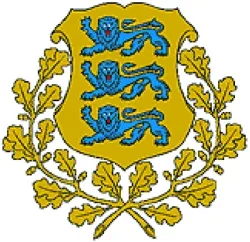
Coat of Arms
The Estonian coat of arms features three blue lions passant guardant on a golden shield, framed by golden oak branches. The three lions trace back to 1219, when they were adopted as part of the coat of arms of Tallinn and the surrounding province, inspired by Danish heraldry. In 1925, the three-lion design was officially confirmed as the national coat of arms of the Republic of Estonia.
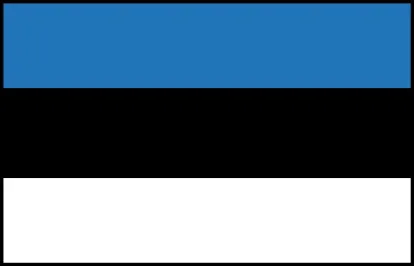
National Flag
The Estonian national flag is a horizontal tricolour of blue, black, and white. First adopted in 1881 by the Estonian Students’ Union in Tartu as their fraternity colours, the tricolour quickly evolved into the symbol of the broader national awakening. In 1920, the blue-black-white flag was formally recognized as the state flag of independent Estonia.
- Blue: Reflects the Nordic sky, seas, lakes, and loyalty to the homeland.
- Black: Represents the fertile soil, national perseverance, and the historical struggles of the Estonian people.
- White: Signifies pure snow, personal honesty, and bright hopes for the future.
National Anthem and Emblems
- National anthem: "Mu isamaa, mu õnn ja rõõm" (My Fatherland, My Pride and Joy) shares its melody with the Finnish national anthem, composed by Fredrik Pacius, with lyrics written by Johann Voldemar Jannsen during the national awakening.
- National flower: Cornflower (Centaurea cyanus), chosen in 1968 for its delicate blue hue reminiscent of the national flag.
- National bird: Barn swallow (Hirundo rustica), honoured for its free flight and traditional closeness to rural Estonian homes.
- National fish: Baltic herring (Clupea harengus membras), a staple of Estonian coastal life and cuisine.
- National stone: Grey limestone, ubiquitous across northern and western Estonia and central to historic stone architecture.
Information Resources
For those seeking to explore, study, or relocate to Estonia, several comprehensive guides and institutional portals provide official information:
- Visit Estonia: Tourism resources, travel guides, regional itineraries, and cultural highlights at visitestonia.com.
- Estonica Encyclopedia: Detailed encyclopedia covering Estonian culture, history, nature, and society at estonica.org.
- Invest in Estonia: Business guides, economic data, startup ecosystems, and investment frameworks at investinestonia.com.
- Ministry of Foreign Affairs: Diplomatic relations, consular guidelines, and international policy updates at vm.ee.
- Destination Estonia Relocation Guide: Practical guidance for expatriates, professionals, and international students settling in Estonia.